
Disclaimer: Hobbyist synthesis from labels, books, and experienced keepers — not veterinary diagnosis. Test water first. Verify doses on current product labels. Weigh salt (tsp last resort). Species differ. Escalate to an aquatic vet when needed. Full text: About / Disclaimer.
First response · Symptom index · Disease cards · Treatments & salinity · Escalate / stop · Gaps
Sick Fish Guide
Symptom → likely causes → what to check → treatments. Water quality before bottles.
1. First response / quarantine / water tests
- Stop and look — How many fish? How fast did it start? Any new fish, plants, décor, meds, or water-source change in the last 2 weeks?
- Test the water now — ammonia, nitrite, nitrate, pH, temperature. If you can: GH/KH. Write numbers down.
- Aerate — Gasping or lethargy → add air stones / increase surface agitation immediately. Never turn off pumps overnight in planted/algae-heavy systems.
- Match replacement water — Same temperature (±1–2°F), dechlorinated, pH close to tank. Sudden pH or temp swings cause “shock” that looks like disease.
- Partial water change — If ammonia or nitrite > 0, or fish are gasping/streaked: large change with matched water. Do not stack medications on fried gills (dark red / brown gills).
- Quarantine when practical — Move the sick fish (or the healthy ones) to a bare hospital tub/tank with heater, air stone, and daily water changes. Hospital = observation + control, not automatic antibiotics.
- Quick physical (wet hands, support over water):
- Gills: cherry red = healthier; dark red/brown = toxins or heavy parasites; pale pink = anemia/stress/med toxicity; “hamburger” / gloppy = parasites.
- Belly: firm vs mushy vs rock-hard; red vent; dumpiness near peduncle.
- Mouth: red roof / white threads → think columnaris / systemic bacteria.
- Slime: thick/mucousy often parasites or toxins; “dry” patchy often columnaris/velvet.
- Poop: chunky food-colored = OK; long thin white = stress or internal bacteria; clear bubbly = not eating.
- Rule out non-disease killers first — gravel stuck in mouth (“rockitis”), chlorine, ammonia/nitrite, overnight oxygen crash, pesticide drift into ponds.
- Do not raise heat or dose harsh meds until parasites are considered. Warmth can explode flukes, costia, ich, etc.
- Wait ~24 hours after water quality is corrected and light salt (see treatments page) before stacking more drugs — unless the fish is crashing (severe pinecone, open ulcers, mass flashing + gasping).
Salinity reminder: Supportive “light salt” for many freshwater goldfish protocols is about 0.1% = 1 ppt = 1000 ppm ≈ 3.8 g / US gallon. That is not 0.1 ppm. Use a kitchen scale; tsp is last resort. Full table on treatments.
2. Symptom index
One symptom can have several causes — check water first.
| Symptom | Likely causes (start here) | What to check | Go to |
|---|---|---|---|
| White spots like salt/sugar grains | Ich (white spot); breeding stars if only on gill covers / pec rays | Temp swings; water params; flashlight at night | Ich |
| Dusty / yellow velvety patches | Oodinium (velvet) | Flashlight near dorsal; slime scrape if available | Oodinium |
| Flashing / scratching | Flukes, costia, trichodina, ich, poor water | Persistent vs occasional; chin red dots; dead organics | Flukes, Costia, Trichodina |
| Clamped fins, lethargy, thick slime | Chilodonella, water quality, early parasites | pH, ammonia/nitrite; cooler water history | Chilodonella |
| Gasping / piping at surface | Low O₂, gill flukes, ammonia/nitrite, acidosis, branchiomycosis | Aeration, morning pond O₂, gill look, water tests | Gill flukes, Acidosis |
| Pinecone scales / bloating / both eyes bulging | Dropsy (symptom, not a disease) — bacterial, parasitic, toxic, temp shock, kidney | Ascites vs pinecone; parasites first; NO heavy NaCl | Dropsy |
| White threads at mouth / cottony sores / red vent | Columnaris (often with organics + parasites) | Mouth, vent, “dry” slime, mushy belly | Columnaris |
| Red sores / ulcers | Aeromonas (white edge, red center) vs columnaris (red edge, white center); costia red dots under chin | Temp history; parasites; wound care | Aeromonas, Wound protocol |
| Red streaks in fins/body | Ammonia/nitrite burn vs systemic bacteria | Gill color; water tests before antibiotics | First response |
| Visible worm / Y-fork / shield with eyes | Anchor worm (Lernaea), fish louse (Argulus), leech | Naked eye; treat wound after removal | Anchor worm, Lice |
| Black spots on skin | Ammonia burn healing vs digenean black-spot (snails) | Water params; snails; 48h salt/WC trial for burns | Black spot |
| Floating / upside-down / sinking | Overfeeding, gulped air from dry floating pellets, constipation, eggs, toxins (H₂S), adhesions, rare true swim-bladder damage | Feed history; gravel siphoning; belly physical — not folk “garlic” cures | Floating / SBD |
| Yawning / head-standing suddenly | Gravel in mouth (rockitis) | Look in mouth; remove stone | Rockitis |
| Thin body, big head, eating but wasting | “Skinny disease” (bacterial), parasites, poor nutrition, mycobacteria (chronic) | Chronic vs acute; quarantine history | Skinny, Mycobacteria |
| Hole-in-head / lateral-line pits | Hexamita / nutrition / stress (more common in some tropicals than goldfish) | Diet, crowding, carbon media theory | Hexamita |
| Chronic lethargy + poor appetite, no parasites on scrape | Internal bacterial; mycobacteriosis; water/organ issues | History of failed multi-med courses; escalate | Mycobacteria, Escalate |
| Sudden death of largest fish first | Oxygen crash, toxins, pH/ammonia spike | Morning pond O₂; organics; aeration | First response |
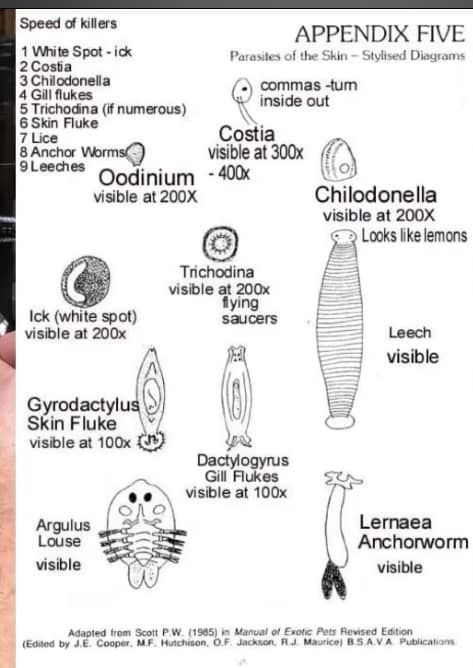
Parasite visual ID: diseases → parasite chart and parasitechart.jpg.
3. When to escalate / stop treatment
Stop or pause treatment if
- Gills are fried (dark red/brown) and you were about to add formalin, malachite, PP, or other harsh baths — fix water and oxygen first; medicated food may be safer than water meds.
- Fish worsens within hours of a new med or heat jump — reverse the last change (cooler matched water, fresh aerated water, neutralize PP with peroxide only if you know the procedure).
- You mixed chemicals that must never combine (e.g. potassium permanganate + formalin → fire/explosion risk).
- Course finished on schedule with no symptoms — stop; do not “keep dosing just in case.”
- Only one eye bulges after bump/spawn — mechanical; clean water + light salt, not full dropsy heat protocol.
Escalate to an aquatic vet / lab when
- Multiple fish die despite corrected water and a completed, appropriate course.
- Chronic wasting, granuloma suspicion, or mycobacteria on the differential (zoonotic caution; gloves; no reliable OTC cure).
- You need injectables, culture/sensitivity, or necropsy.
- Legal / prescription drugs are indicated in your jurisdiction.
- You are unsure of species-specific salt or heat tolerance (e.g. some Israeli koi lines, scaleless fish).
Do not
- Stack every bottle on the shelf at once.
- Raise temperature for “bacteria” while untreated parasites are likely.
- Use heavy NaCl on pineconing dropsy (dropsy is generally treated as an electrolyte problem — prefer carefully dosed Epsom, not table salt).
- Pop lumps/ulcers.
- Flush euthanized fish (local disposal rules; clove-oil euthanasia notes are on the treatments page for humane end-of-life only).
- Chase folk remedies (garlic floats, magic foods, etc.) instead of water tests and labeled protocols.
4. Gaps & honesty
- Salt math: The hobby rule of thumb equates ~1 tsp/gal with 0.1%. Mass-based math says true 0.1% ≈ 3.8 g/gal (~0.75 tsp @ 5 g/tsp). This guide follows the corrected table. Weigh salt.
- Products: Quick Cure, Romet-type foods, Dimilin, Baytril, Panalog, oxolinic acid, chloramphenicol, etc. may be unavailable, renamed, restricted, or vet-only. Prefer current labels + vet guidance.
- Heat protocol (84–86°F): Goldfish-hobby approach for some bacterial/dropsy cases; risky if parasites present; oxygen demand rises; not universal for all species.
- H₂O₂ fluke dip: A very short dilute dip is used; overdose destroys gills. Praziquantel per label is the other option.
- Mycobacteriosis: No reliable OTC cure; zoonotic caution; isolate and escalate rather than stacking more meds.
- Goldfish-centric: Tropical fish need different salt ceilings and temperatures.
- Re-check: Verify against current labels and vet guidance before treating.