Name and history · Top view and side view · Styles of head growth · Tail · Colors · References
Oranda
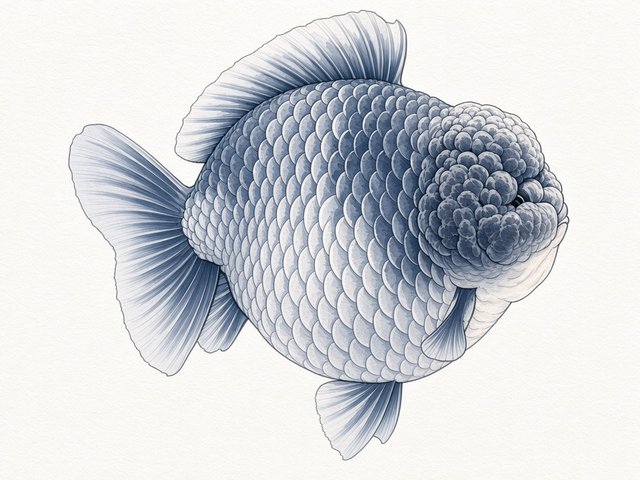
The oranda is a twin-tailed goldfish with a dorsal fin and a fleshy head growth, the wen. The head is the oranda’s defining feature, and the body and tail are designed to complement it. Most goldfish today are viewed from the side in aquariums, as opposed to from the top in ponds and bowls, though some varieties are still bred to be viewed from above (see Top view and side view).
Name and history
Oranda is the Japanese word for Holland. The fish reached Japan through Dutch trade, so the Japanese called it オランダ獅子頭 (oranda shishigashira), the lionhead from Holland. The fish itself came from China. It most likely arrived through the port of Nagasaki in the 1830s, spread north through Kyushu to the Osaka area, and was not seen around Tokyo until late in the 1800s. Other Japanese accounts say the Japanese oranda was made locally by crossing a ryukin with a ranchu.
In the early 1900s Japan led the world goldfish trade, and its word spread with its fish. Traditionally, a goldfish with a dorsal fin and head growth is an oranda, and most of the world now uses the word the same way.
Chinese goldfish culture goes a step further and sorts them by the shape of the head growth. Names such as high head (高头 gāotóu), lion head (狮头 shītóu) and goose head (鹅头 étóu) can be used for fish with or without a dorsal fin. The term oranda is widely accepted for the dorsal-fin fish, with the head types as its variants. The variety tree shows where these fish sit in that scheme.
Tails have changed over the years as well. Old drawings show orandas with long, drooping tails, and a thin, long swallowtail type was once kept but has disappeared. Today most orandas carry a tail of medium length.
Top view and side view
Orandas fall into two main types, according to how they’re meant to be viewed. Goldfish were first kept in ponds and bowls, where people looked at them from above, so the earliest orandas were bred for the top view. Fish kept in aquariums are seen through the glass, so they are bred to be appreciated from the side. Most orandas today are side view fish.
Top-view oranda
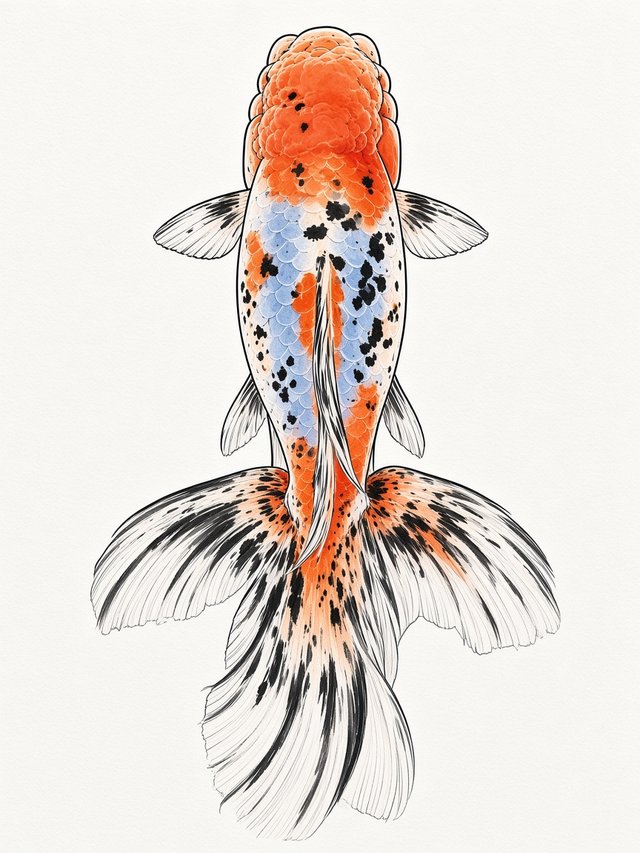
A top-view oranda is bred to look best from above with its tail spreading out horizontally and its head strong and squared at the front. The Japanese oranda is the top-view type.
Japanese oranda
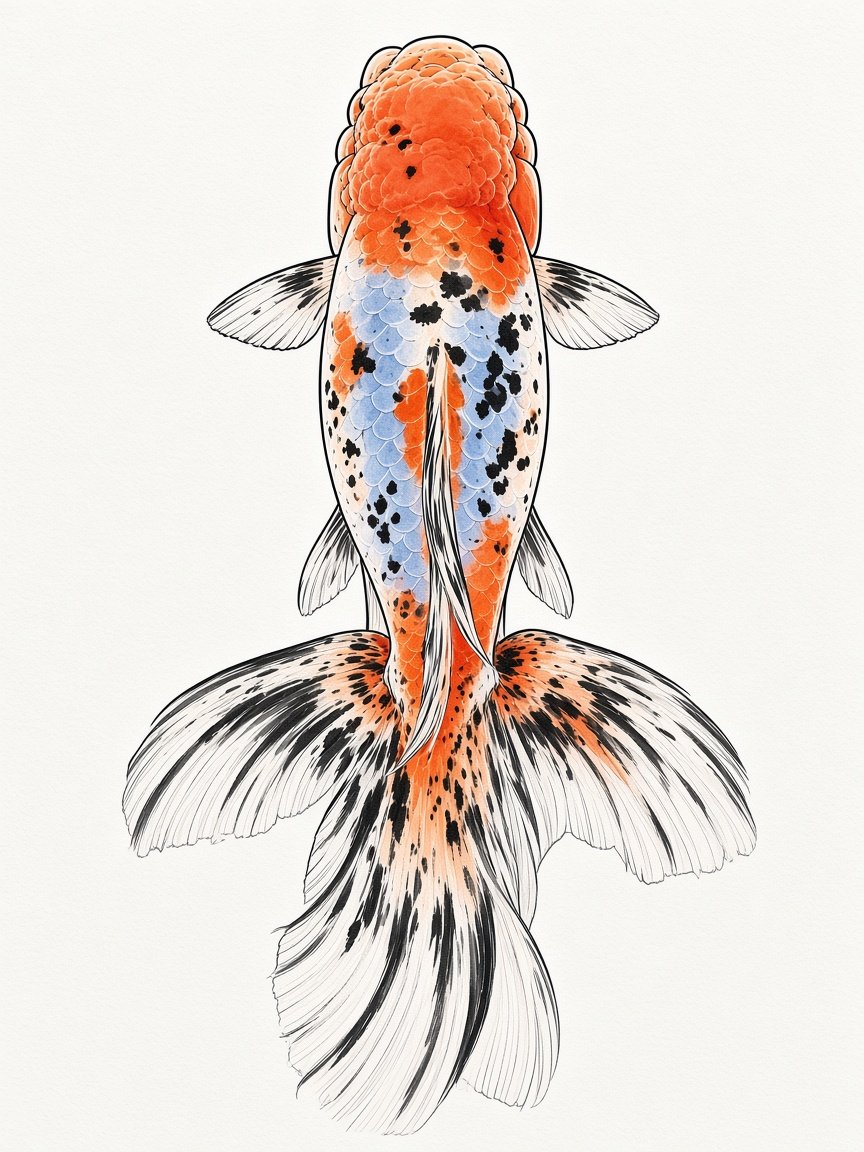
The Japanese oranda most hobbyists will meet is the calico fish shown here, traditionally called the Azuma nishiki. It was made in the 1920s by crossing an oranda with a calico telescope-eye (demekin), and it has the same build as the plain-colored Japanese orandas below. It carries strong calico color: ideally deep red on the head, blue on the body and black on the tail, in bold open patches with black scales as accents. Keepers enjoy color variants of the Azuma spawns, so other options are becoming more popular, like black and heavy sky blue without as much red. When breeding these fish the red can be very dominant, so pick breeders with black and blue and a little red on the head. Always breed calico to calico. Its tail should spread out like an umbrella.
Japanese oranda in other colors
The Japanese oranda also comes in plain colors, as the Oranda Shishigashira, in orange and in an intense red-and-white. These fish exist, but they are far less popular than the calico, and in the US they are hard to find or not available at all. The build is the same for every color:
- Body and tail: traditionally long in both, and one of the largest Japanese varieties, reaching about a foot (30 cm).
- Back: no ryukin-style hump; the back does not rise up.
- Head growth: heavy and covering the whole head.
- Tail: four lobes, held closed while swimming and spread wide when the fish stops.
- Peduncle: thick and long.
Side view oranda
The side view oranda is one of the more popular varieties these days. These fish should look powerful and robust as they swim, like they own the aquarium. The exact specifications vary depending on where they originated and which standard you are using. Breeders around the world continue to push the form in new directions. I have seen them referred to as Chinese, Thai, different variants based on form like the yuan bao (ingot), even down to the farm, like the Shogun. It makes it hard to keep up when the nomenclature originates in different languages and is always changing.
The side view oranda is a very different fish from the long Japanese type:
- A big head. The head is large for the body, and has varying styles of head growth.
- Arched back. A deep, rounded, muscular body whose back arches slightly above the head growth.
- Short, thick peduncle. A short but thick tail stalk.
- Balanced weight: the body often looks evenly weighted from top to bottom, though a big belly can be charming. Females have a wider, softer belly.
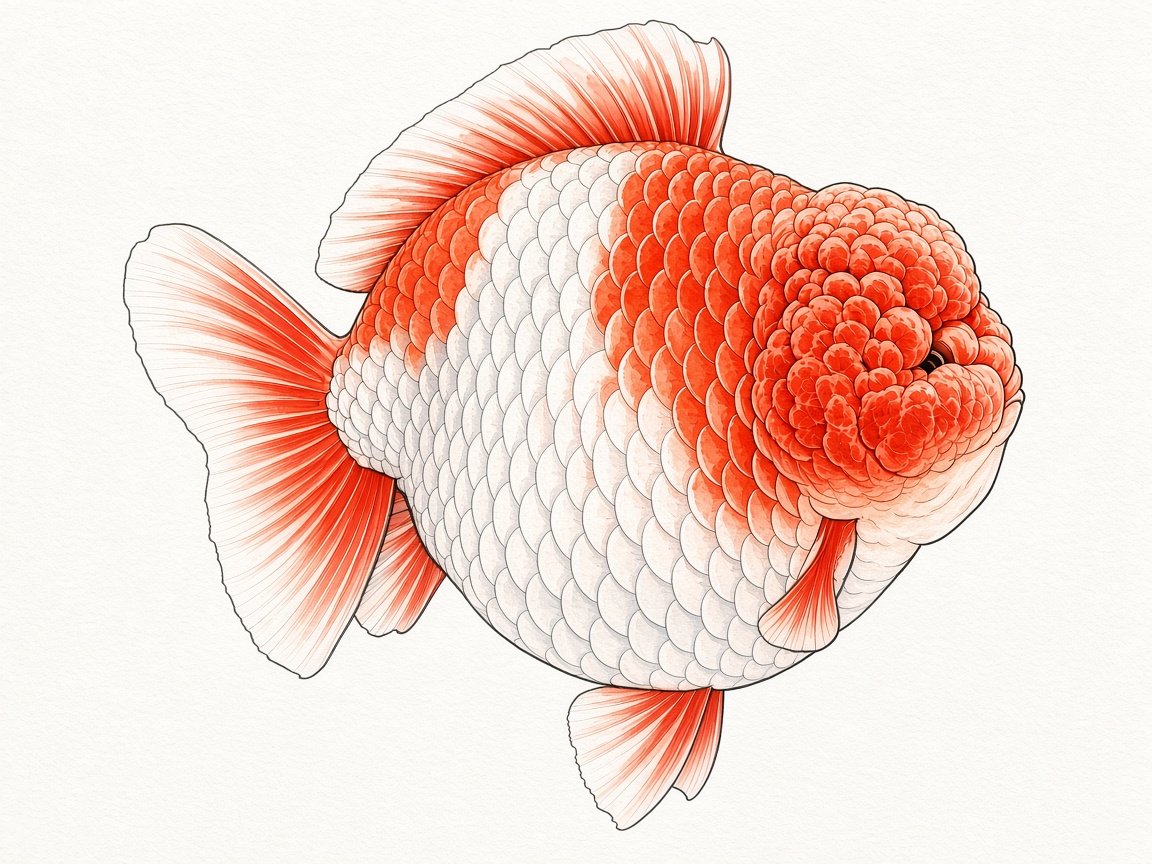
Breeders in Thailand made the buffalo head popular (see Styles of head growth), and they developed the medium-length tail that most orandas now carry.
Not every side view oranda carries a buffalo head. Breeders in China name their lines by head type (see Styles of head growth), so side view orandas are also seen with a lion head, a high head or a goose head. In the West the best-known of these head-type lines is the red cap.
The lines bred in Thailand most likely grew out of lines from China, and so much crossing has gone on since that the lines get muddy. Together they make up the side view oranda, the fish the yuan bao builds on.
Yuan bao (ingot) oranda
Yuan bao (元宝) is the boat-shaped gold ingot of old China, a symbol of wealth. The name fits the fish: seen from the side, the high head, high back and upturned tail make an ingot shape. It is a recent line from China with a short, high, round body, a big head growth, short fins and a short tail that turns up. Breeders in China describe it as the buffalo head of the side view oranda on the body and tail of a short-tailed ryukin. Accounts of its origin differ: breeders in China say it came from crossing buffalo-head side view orandas with short-tailed ryukins, while Western dealers usually call it a ryukin × ranchu cross.
Styles of head growth
Whatever the type, the head is the first thing you notice. A healthy oranda holds level in mid-water at rest and swims easily, driven by a strong peduncle, without wobbling its head and body.
Head growth is grouped by where it grows on the head. Most of the names compare the head to an animal.
- Tiger head (虎头 hǔtóu). Dense growth on top of the head, on the sideburns, under the eyes and on the snout, while the gill covers stay fairly smooth. That smooth gill cover is what separates it from lion head.
- Lion head (狮头 shītóu). Rich growth over the whole head, gill covers included, like a male lion’s mane. Lion heads vary in shape more than tiger heads.
- Goose head (鹅头 étóu). Growth on top of the head only, like a hat or crown, with nothing on the cheeks, chin or gill covers, and usually nothing on the snout. It recalls the knob above a goose’s bill.
- Dragon head (龙头型 lóngtóu xíng). A newer type, added for imported Japanese and Thai fish that didn’t fit the traditional goose, tiger and lion types. Seen from above the head is square, with moderate, neat, firm growth like a sculpture, and the snout sticks out more than on any other type. Cheek and gill growth is light, between tiger and goose head.
- Buffalo head. Head growth all around, with large cheek growth known as funtan.
High head (高头) and similar names are variations on these basic types. So much crossing has gone on that many fish today have heads that fit no single type.
Goldfish writers don’t always agree, and much of that comes down to what each one learned from their mentors, which is why this gets confusing. Matsui has his views, Man Shek-hay’s research in Hong Kong shows another, and the sources and research behind Goldfish of China show another again. All of them are relevant and all of them matter. Together they’re a good reminder not to get too stuck on what a fish is supposed to be.
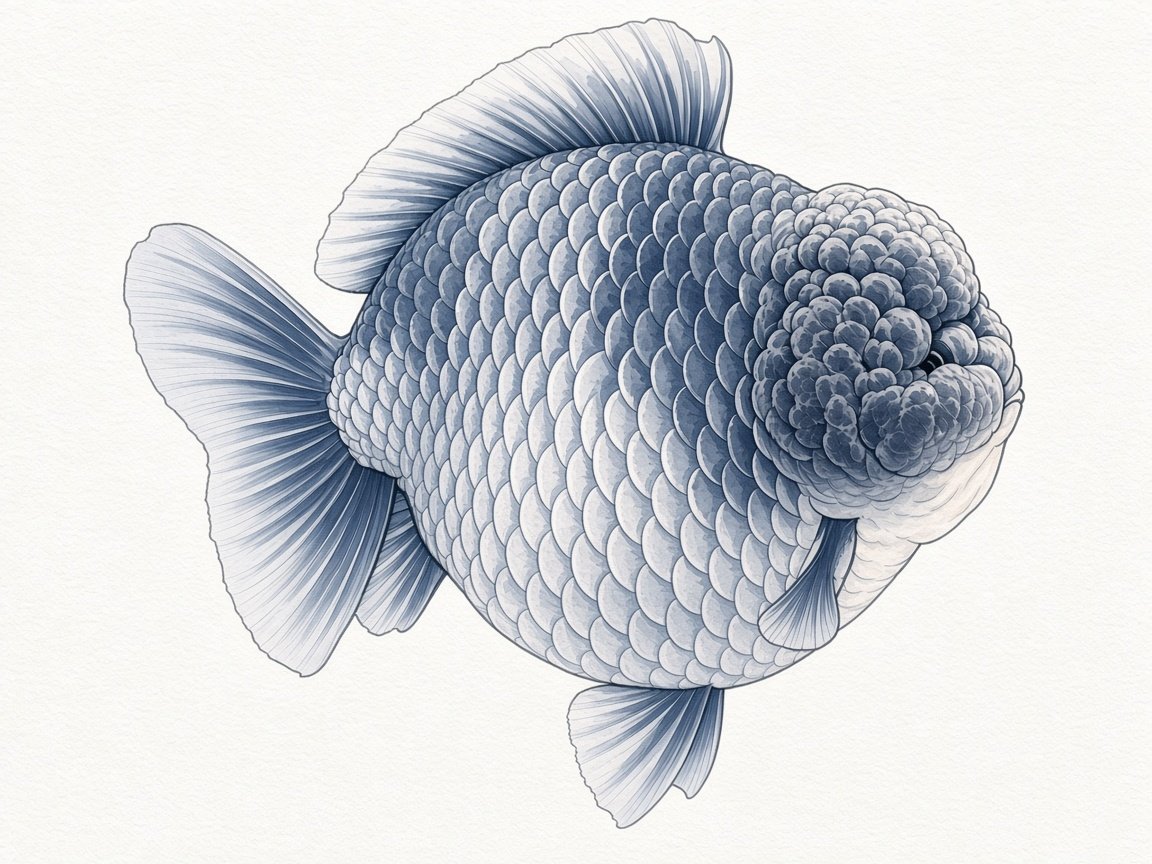
Why “wen”? It sounds Chinese, but it isn’t. Lei of Goldfish Corner traced the word and found it doesn’t come from Chinese or Japanese. Australian keepers probably started using it, borrowing the Old English wen, a cyst on the skin. Americans said “head growth” and the British said “hood”, and since the late 1990s all three have been folding into “wen”. Research: Goldfish Corner, The Mystery of Goldfish Wen (2020).
Tail
Tail length and stiffness
- Tails can vary in length and shape. Older style oranda have forked tails. Broad tails have become popular on side view fish. Some breeders go so far as to name the tail after a flower such as peony or rose.
- Long tail. Long tails can be harder to keep healthy. All that fin is heavy to haul and makes it harder to fight the current, so the fish is slow to get to food and can’t escape aggressive tankmates. It also tears easily on rough decor, nets, filter intakes or a nipping tankmate, and a torn fin is an easy way in for fin rot. Keep the water extra clean and the flow gentle.
- Hard and soft tails. A tail stays spread and upright when the tail base is strong, the fin tissue is thick and the rays are hard. Hard tails hold their shape; soft tails swish like a dress as the fish swims.
Tail shape
- Side view: wide spread, with the upper lobe standing up from an angle at the peduncle. Split, with the two halves matching in length and height.
- Top view: wide horizontal spread, like an umbrella mounted upside down at the peduncle.
Colors and named types
Oranda come in just about every color and scale type available to goldfish, and what a color is called depends on who is naming it. The same fish can go by a different name in Japan, China and the West; names also change over time. The table below lists every color name and combination we’ve come across and where each one came from: Goldfish Guide (Matsui, 1972), Goldfish of Hong Kong (Man Shek-hay, 1993), Goldfish of China (2017, in the book’s own English names), Goldfish Appreciation (Tong and Hermanto, 2020) or hobby/trade usage.
Calico shows the difference best. On this page calico means the five-color transparent-scale fish: red, white, black, yellow and blue. Matsui notes that in Japan in 1972 “calico” originally meant a red, or dappled red-and-white, fish with no blue or black. That was the convention in his country and his day, and a good example of how naming differs from place to place and year to year.
| Color or combination | Names, and where they came from |
|---|---|
| Red, orange and yellow | orange or red, the most common color, treated by keepers as one color because a good orange deepens to red; yellow, rarely seen now and often mistaken for washed-out orange (hobby/trade usage) · all red; orange-yellow (Matsui 1972) · “Red” (Goldfish of China 2017) |
| White | “White” (Goldfish of China 2017) |
| Black | black, though true solid black is hard to find (hobby/trade usage) · black (Matsui 1972) · “Black” (Goldfish of China 2017) |
| Blue | blue, a silvery blue like a Russian blue cat, rare in goldfish generally but easy to find in orandas (hobby/trade usage) · blue, in China (Matsui 1972) · “Blue” (Goldfish of China 2017) |
| Lilac | “Lilac” (雪青) (Goldfish of China 2017) |
| Brown | chocolate (also sold as bronze or tea-colored, cha-kin), brown fish, still common, sometimes with pompoms in front of the nostrils (hobby/trade usage) · brown and blue-brown, in China (Matsui 1972) · “Chocolate Blue” (紫蓝), “Chocolate Red” (紫红) (Goldfish of China 2017) |
| The wild color | Crucian gray (Matsui 1972) |
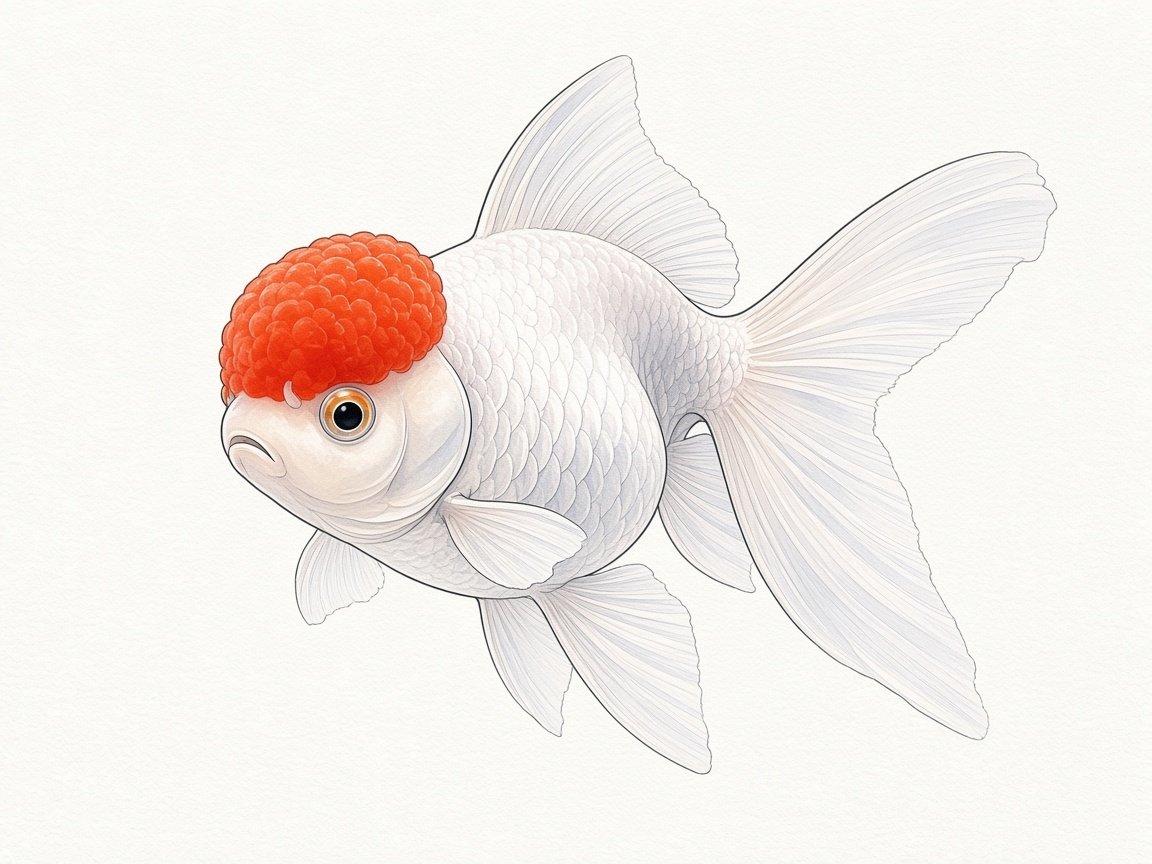
| White with a red cap | red cap (鹤顶红 hèdǐnghóng, “red-crowned crane”), a goose-head fish that is white all over except a red cap on top of the head. The red stays on the cap: a fish with red on the rest of the head, down to the mouth, or on the body or fins is not a red cap. This pattern is almost unique to the oranda; it is also seen in the dorsal-less Royal goosehead, aka goose head red. Red-crested goldfish are said to go back to the Ming dynasty, when the red was a flat spot rather than a raised cap (hobby/trade usage) · red crane crest (鶴頂紅) (Man Shek-hay 1993) · “Red Cap Oranda”, “Red Cap Oranda Broad Tail” (宽尾鹤顶红) (Goldfish of China 2017) |
| Red head on a bronze or black body | red head bronze (朱頂紫高頭), the “doll goldfish”; red head black (朱頂黑高頭) (Man Shek-hay 1993) |
| Red-and-white | red-and-white, in endless patterns; named head patterns include the jade head (a white cap with red elsewhere), red lips (like lipstick; spread wider, it looks like a moustache) and marks that match left and right (hobby/trade usage) · red and white (Matsui 1972) · “Red White”, “Red White Oranda” (红白高头) (Goldfish of China 2017) |
| Translucent red-and-white | sakura, red-and-white with translucent (nacreous or matt) scales (hobby/trade usage) · red and white transparent (紅白透明高頭) (Man Shek-hay 1993) · “Sakura Oranda (Lionhead Type) (Red White Matt)” (樱花狮头) (Goldfish of China 2017) |
| Metallic red-and-white | sarasa (hobby/trade usage) |
| Black-and-white | panda (熊猫 xióngmāo); black-and-white fish were once also called magpie, but panda is now used for both. Usually not permanent: the black tends to fade and leave a white fish (hobby/trade usage) · magpie (喜鵲花) (Man Shek-hay 1993) · “Black White” (Goldfish of China 2017) |
| Black-and-orange, red-and-black | Apache or black gold, a Southeast Asian name for black-and-orange fish. It appears as young fish lose their black and the orange comes through, and it usually ends in a plain orange fish. Fish with a sharp line between black and orange tend to hold the pattern longer (hobby/trade usage) · “Red Black” (Goldfish of China 2017) |
| Blue-and-white | “Blue White” (Goldfish of China 2017) |
| Blue head | blue face (關公面, also 藍面) (Man Shek-hay 1993) |
| Red, black and white | tricolor, a white fish with spots of deep black and red; metallic tricolor, a different, rarer fish from a transparent-scale calico (hobby/trade usage) · “Red Black White” (三色) (Goldfish of China 2017) |
| Five-color calico (red, white, black, yellow and blue, transparent scales) | calico, a transparent-scale fish almost always defined by these five colors; tiger, often used for a red base with a black striped pattern (hobby/trade usage) · variegated (五花高頭); blue variegated (石花藍高頭) (Man Shek-hay 1993) · “Calico” (花狮头), “Calico … (Bluish Base)” (五花) (Goldfish of China 2017) |
| Japanese calico oranda | Azuma Nishiki, the top-view calico (hobby/trade usage) · azumanishiki, red, white, black, blue and orange-yellow with fine black dots (Matsui 1972) · “Azumanishiki (Japanese Calico Oranda)” (东锦) (Goldfish of China 2017) |
| Japanese oranda in plain colors | Oranda Shishigashira, in orange and red-and-white (hobby/trade usage) · “Oranda Shishigashira (Japanese Oranda)” (日狮) (Goldfish of China 2017) |
| Patterns and finishes | “Marble” (云石), “Water Pattern” (水墨), “Tiger Banded” (虎纹), “with Bluish Matt and Black Dots” (撒锦), “Kirin” (麒麟), “with Intense Colors” (重彩) (Goldfish of China 2017) |
| Other named types | twelve red (十二紅); red and bronze with velvety balls (紅絨球高頭, 紫絨球高頭) (Man Shek-hay 1993) · “Ranchu with Dorsal Fin” (扯旗兰寿) in chocolate, lilac and red-and-white (Goldfish of China 2017) |
Color names by book
Color names shift with the country and the decade, so it’s worth seeing which names come from which book.
Goldfish Guide (Yoshiichi Matsui, 1972). Matsui gives the oranda as all red, red and white, orange-yellow, Crucian gray (the wild color) and black, and says China also had blue, blue-brown and brown. His calico oranda is the azumanishiki: red, white, black, blue and orange-yellow with fine black dots, and most striking with solid black on the head.
Goldfish of Hong Kong (Man Shek-hay, 1993). Man Shek-hay calls every dorsal-finned fish with head growth a high head (高頭) and names these colors:
- Red crane crest (鶴頂紅). The red cap, the oldest of them. It goes back to around 1590, in the Ming dynasty, when it was just a red spot.
- Red head bronze (朱頂紫高頭), the “doll goldfish”. About 30 years old in 1993. The bronze tends to fade toward red. Red head black (朱頂黑高頭) is the black version.
- Twelve red (十二紅).
- Red and white transparent (紅白透明高頭). The translucent red-and-white.
- Magpie (喜鵲花). Black and white, in short-finned and long-finned forms.
- Blue face (關公面, also 藍面). Brand new in 1993, from a Hong Kong farmer. The blue head can sit on a red, white or red-and-white body, and a blue head on an orange-red body is the best.
- Variegated (五花高頭). Black in stripes or scattered dots, with bright, contrasting colors and a red head preferred. Sesame-spotted and red-crested forms exist. Blue variegated (石花藍高頭) is the blue version.
- Red and bronze with velvety balls (紅絨球高頭, 紫絨球高頭). High heads with pompoms.
Goldfish of China (2017) sorts its oranda colors by head type. These are the book’s own English names:
- Goose head: “Red Cap Oranda” (鹤顶红), “Red Cap Oranda Broad Tail” (宽尾鹤顶红) and “Red White Oranda” (红白高头).
- Tiger head: “Red”, “White”, “Blue”, “Lilac” (雪青), “Red White”, “Chocolate Blue” (紫蓝), “Red Black White” (三色), “Marble” (云石), “Water Pattern” (水墨), “Tiger Banded” (虎纹), “with Bluish Matt and Black Dots” (撒锦), “Kirin” (麒麟), “with Intense Colors” (重彩) and “Calico … (Bluish Base)” (五花). In Chinese every one of them is still called 狮头 (lion head), even though the book files them as tiger heads.
- Lion head: “Black”, “Blue”, “Red White”, “Red Black”, “Chocolate Red” (紫红), “Black White”, “Blue White”, “Chocolate Blue”, “Red Black White”, “Sakura Oranda (Lionhead Type) (Red White Matt)” (樱花狮头), “with Bluish Matt and Black Dots”, “Calico” (花狮头), “Kirin”, “with Intense Colors” and “Calico … (Bluish Base)”, plus “Ranchu with Dorsal Fin” (扯旗兰寿) in chocolate, lilac and red-and-white.
- Dragon head: “Azumanishiki (Japanese Calico Oranda)” (东锦) and “Oranda Shishigashira (Japanese Oranda)” (日狮).
The 1993 and 2017 books meet in places. Both name a translucent red-and-white (Man Shek-hay’s 紅白透明, Goldfish of China’s sakura), both name the variegated 五花, and both put the red cap with the goose head.
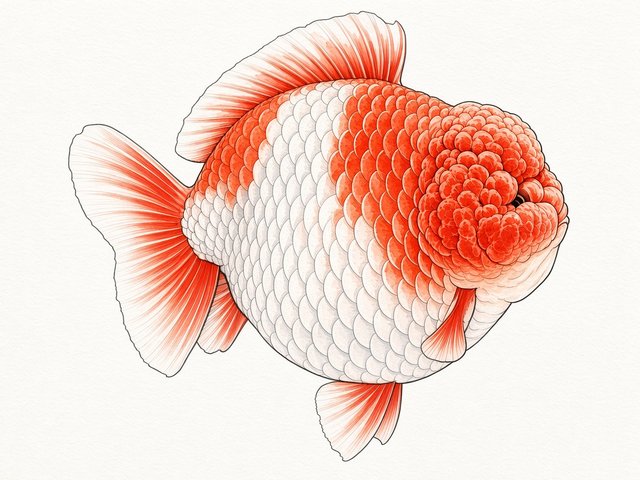
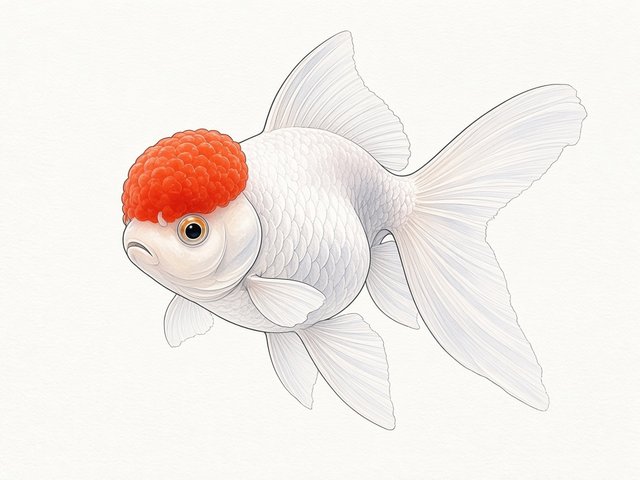
A fellow goldfish breeder lost his fish house to a fire. Some of his fish survived. Help Tim Asbill rebuild →
Related: Variety tree · Ranchu · Tosakin · Oranda hologram
References: Yoshiichi Matsui, Goldfish Guide (1972) · Man Shek-hay, Goldfish of Hong Kong (1993) · Goldfish of China (中国金鱼图鉴, 2017) · Steven CS Tong and Hermanto, Goldfish Appreciation (2020) · Goldfish Corner (YouTube).