
Disease & parasite cards
Practical cards from hobbyist practice + parasite chart. Doses and protocols on Treatments.
Parasite chart · Ich · Velvet · Costia · Chilodonella · Trichodina · Skin flukes · Gill flukes · Anchor worm · Lice · Columnaris · Aeromonas · Dropsy · Floating · Mycobacteria · Other
Parasite ID chart (skin)
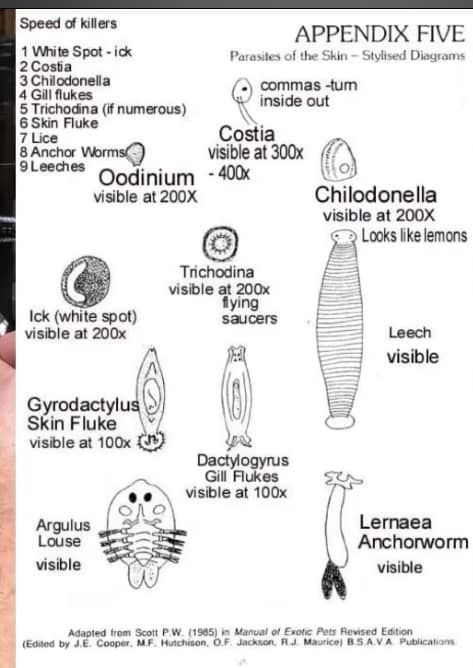
Adapted from Scott P.W. (1985) in Manual of Exotic Pets, revised edition (ed. J.E. Cooper, M.F. Hutchison, O.F. Jackson, R.J. Maurice), BSAVA Publications. Use with a microscope when possible.
Speed of killers (order as listed on the chart above — treat fast killers first)
- White spot (Ich)
- Costia
- Chilodonella
- Gill flukes
- Trichodina (if numerous)
- Skin fluke
- Lice
- Anchor worms
- Leeches
| Parasite | Look / mnemonic | Typical magnification |
|---|---|---|
| Oodinium | Small oval | ~200× |
| Costia | “Commas — turn inside out”; flagella | ~300–400× |
| Chilodonella | “Looks like lemons”; ridged oval | ~200× |
| Ich (white spot) | Round; dark horseshoe / C-shaped nucleus | ~200× (tomont lower power) |
| Trichodina | “Flying saucers”; gear ring + rim cilia | ~200× (motion often ~100×) |
| Gyrodactylus (skin fluke) | Elongate; hooks at haptor | ~100× |
| Dactylogyrus (gill fluke) | Similar; four eye-spots at head | ~100× |
| Argulus (louse) | Flat shield, eyes, legs | Naked eye |
| Lernaea (anchor worm) | Worm body; forked tail; buried anchor | Naked eye |
| Leech | Segmented worm | Naked eye |
Ich (white spot)
- Symptoms: Salt/sugar-grain white spots; may form slimy masses when severe.
- Likely causes: Ichthyophthirius; often after temperature swings or stress.
- Check: Temp stability; ammonia/nitrite; nets/equipment hygiene (sticky tomonts).
- Treatments: Formalin/malachite green products on a multi-day schedule with water changes; some keepers used 3% salt dips + daily treatment while warming gently (~72–74°F). Cycle length is temperature-dependent (~days at warm temps, weeks when cold).
- Cautions: Feeding stage under skin resists meds; free-swimming stage is the target. Harsh baths on fried gills are dangerous. Disinfect nets. Verify current product labels.
Oodinium (velvet)
- Symptoms: Lethargy, flashing, dry patchy skin, yellowish dusty look, heavy slime.
- Check: Flashlight at night near dorsal fin; scrape if available (~200×).
- Treatments: Water changes, salt dip, formalin/malachite-type courses (~3 days).
- Prevention: Quarantine new fish; improve organics/water quality.
Costia (Ichthyobodo)
- Symptoms: Flashing; tiny red hemorrhages under chin / along back; thick slime.
- ID: Fast jerky motion; comma/kidney shape; high power for flagella. Divides quickly ~75–78°F; die-off ~86°F.
- Treatments: Salt dip to strip slime → multi-day formalin/malachite-type treatment → some protocols then warm carefully. Rule out bacteria if red dots are under scales.
- Caution: Heat without clearing other parasites can worsen mixed infections.
Chilodonella
- Symptoms: Clamped fins, gasping, lethargy, hiding, thick slime.
- Notes: Cooler-water problem (winter ponds). Rule out pH first.
- Treatments: 3% salt dip then formalin/malachite-type course with daily partial changes; ponds: therapeutic salt (see corrected table — weigh; do not guess tsp as %).
Trichodina
- Symptoms: Often tied to thick slime / degraded water; spinning “saucers” on scrape.
- Treatments: Clean water first; salt dip; formalin/malachite-type treatment.
- Note: Conditions that over-stimulate slime can increase numbers.
Gyrodactylus (skin flukes)
- Symptoms: Flashing, listless, frayed fins, thick/rough slime; common on peduncle.
- Biology: These flukes give live birth; worse in warm water and poor conditions. Most fish carry a few.
- Treatments: Praziquantel per label. Salt dips + PP or formalin/malachite are also used, as are very short dilute H₂O₂ dips (high risk — see treatments page).
- Support: Light salt to support slime (mass-based dose).
Dactylogyrus (gill flukes)
- Symptoms: Early — dark red at pectoral bases; later gasping, flared/gloppy gills.
- ID: Four eye-spots; ~100×. Egg layers — retreat/recheck over weeks (hatch ~4 days near 68–70°F).
- Treatments: Praziquantel per label. Salt dips + PP/formalin-malachite are also used (resistance reported); short H₂O₂ dips (dangerous). Bucket-to-bucket moves help leave eggs behind.
- Critical: Do not blast heat for bacteria until gill flukes are addressed.
Lernaea (anchor worm)
- Symptoms: Visible worm with forked tail embedded in muscle.
- Treatments: Remove with tweezers; treat wound topically (antibiotic cream). Ponds: insect growth regulators (availability/legality vary) on a multi-week schedule. Tank outbreaks: strip décor, dry equipment, rotate hospital water daily ~10 days to beat eggs.
- Note: Wounds seed secondary bacteria/parasites.
Argulus (fish louse)
- Symptoms: Flat round ~1/8"; dark eye spots; blood-sucking wounds.
- Treatments: Manual removal + topical wound care; same class of pond arthropod treatments as anchor worm where legal/available. Eggs on décor ~month later — environmental control matters.
Columnaris
- Symptoms: White threads at mouth; dry skin; darkening; cottony/thready sores; peduncle disease; red anal vent; sometimes chronic bubble-eating / balance issues from internal adhesions.
- Check: Mouth & vent; slime “dry”; gill patches; organics/feces load. Often follows parasites + dirty water.
- Treatments: Improve water; topical wounds; medicated foods; potassium permanganate water treatments for external disease (see treatments); injections only via vet.
- Internal: Water antibiotics often weak; food or vet route usually preferred.
Aeromonas / red sores (“spring crud”)
- Symptoms: Red sores (often white edge / red center); blood at pectoral bases for internal infection; pond outbreaks as water warms.
- Check: Parasites almost always present on pond fish — treat parasites before or with care around heat.
- Treatments: Clean wound (peroxide once carefully away from eyes/gills), topical cream; raise immune function with warmth only after parasites addressed; antibiotic food; injectables are vet procedures.
- Note: Many Aeromonas strains dislike high heat (~84°F); exceptions exist. Oxygenate heavily.
Dropsy (symptom complex)
- Looks like: Pinecone scales and/or ascites (swollen, scales flat) and/or bilateral pop-eye.
- Causes: Bacterial, parasitic, viral, toxic water, temperature shock, electrolyte/kidney failure — not one disease.
- Check: Full water panel; physical exam; scrape for parasites; single vs both eyes.
- Common treatment themes: Hospital tank; treat parasites first; little/no NaCl; small Epsom dose (e.g. 1/8 tsp per 5 gal — do not escalate blindly); high aeration; warmth ~84–86°F for weeks in bacterial cases; antibiotic food; move to fresh water regularly.
- Why heat fails: untreated parasites explode; too much NaCl; toxic source water; temp raised too slowly (selects hardy bacteria); toxic useless meds; starvation; stopped too early; untreatable primary cause (e.g. kidney failure / mycobacteria).
- Prognosis: Earlier = better. Ascites with flat scales + no ammonia production often worse (kidney).
Floating / “swim bladder”
- Common causes: Dry floating pellets / gulped air, constipation, egg-bound females, toxins (H₂S from gravel), adhesions, rare true bladder damage, gas-forming gut infection.
- First steps: Soak/sinking food; greens/peas; short fast if otherwise healthy on physical; Epsom-in-pea carefully; check gravel/anaerobic pockets.
- Not folk remedies: We do not recommend floating garlic or superstition-based “cures.” Address feed method, constipation, water, and infection differentials.
- Aggressive methods: Shallow recovery tub, walk the fish upright, heat + Epsom without NaCl, antibiotic food if enteritis/eggs suspected — ammonia monitoring mandatory.
Mycobacteriosis (fish TB)
- Typical picture: Chronic lethargy and appetite loss; fish may waste over weeks despite clean scrapes and multiple failed OTC antiparasitic/antibiotic courses. Internal granulomas (often acid-fast bacilli consistent with Mycobacterium sp.) are a known differential; secondary environmental bacteria can coexist.
- Hobby takeaway: There is no reliable over-the-counter cure. Endless med stacking rarely helps and delays proper decisions.
- What to do: Isolate affected fish; gloves and hygiene (zoonotic potential); escalate to an aquatic veterinarian (diagnostics / euthanasia decisions as appropriate); do not reuse untreated filter media across tanks carelessly.
Other cards (short)
Acidosis (low pH)
Gasping, darting, thick slime, dark gills. pH crash from organics / biofilter death. Raise pH slowly with matched water; aerate; clean organics; buffer (crushed coral / dolomitic lime — not sudden slaked lime). Avoid harsh meds on fried gills.
Alkalosis / high pH + ammonia
Darting, gasping, red streaks, sudden death. Ammonia more toxic at high pH. Common in cycling tanks or leaching concrete. Lower pH gradually; frequent changes until cycled.
Rockitis
Yawning, head-standing, imbalance — gravel stuck in mouth. Remove with rounded tweezers; use gravel too large to swallow or bare-bottom feeding zones.
Hexamita / hole-in-head style lesions
Lateral-line pitting, depigmentation, white threads. Nutrition/stress/mineral theories; metronidazole is used (food preferred). Improve diet and water; reconsider carbon media if suspected contributor.
Skinny disease
Big head / sucked-in look while still eating. Erythromycin-in-food courses are used; also rule out parasites and mycobacteria if chronic.
Black spot (digenean)
Vs ammonia-burn black marks (healing). Needs snails in life cycle. No great OTC kill of encysted metacercaria; manage snails; salt + clean water for secondary infection risk when cysts erupt. Copper only with correct hardness/pH.
Epistylis / carp pox / lymphocystis
Wart-like or greasy buff growths. Clean water; formalin-type products for epistylis; viruses often wait-and-support.
Branchiomycosis
Mottled / bluish-gray gill streaks in hot, organic, low-O₂ water. Hard to treat; salt dips + mechanical removal of crud + antibiotic food + continuous fresh flow. Some koi lines salt-intolerant.
Brain / eye flukes
White fleck in eye, circling. No reliable treatment; eliminate snails.
Gas bubble disease
Bubbles in fins/skin from supersaturated gas (well water, pump leaks). Degas water; do not “medicate.”